QuantWare’s Big Leap: How to Turn Deep‑Tech Momentum into Sustainable Growth
A deep-dive into QuantWare's growth up till now and beyond
When a European deep‑tech company raises a multimillion-dollar round to build core quantum hardware, the ecosystem should take notice. That is exactly what QuantWare, a Delft‑based spin‑out, has just done. The company is building technology to power some of the world’s most powerful quantum processors and has attracted a syndicate that includes Invest‑NL’s Deep Tech Fund, InnovationQuarter, the EIC Fund, and specialist investors such as FORWARD.one and QDNL Participations.
QuantWare is not trying to be “yet another quantum computer company.” Instead, it aims to become the supplier of the processors and amplifiers that sit at the heart of many different systems – the “brains” inside other people’s quantum machines. Their VIO technology promises to crack one of the biggest bottlenecks in superconducting quantum computing: scaling the number of qubits in a single processor towards the million‑qubit level.
That is an ambitious mission. It is also a long one. Quantum hardware sits firmly in the class of markets where scientific progress has outpaced commercial uptake. The key question is no longer, “Can the chips be built?” but “Can they be scaled and commercialised sensibly over time?”
At Growth Lantern, we used a full‑journey commercialisation lens to examine where QuantWare stands today, why it has reached this point, and what its next moves should be to balance big ambition with the patience this field demands. In the following sections, we share our research findings.
1. Why QuantWare matters
To understand why QuantWare’s progress is important, it helps to briefly sketch the context.
Quantum computing is moving from theory and lab experiments to early hardware and software platforms worldwide. Yet most efforts still take the form of vertically integrated stacks: one company or consortium tries to build everything – from qubits to cryogenics, from control electronics to cloud access.
QuantWare’s approach is different:
It focuses on superconducting quantum processors (QPUs) and travelling‑wave parametric amplifiers (TWPAs) – components at the core of many quantum systems.
It sells these to third parties, enabling others to construct complete machines.
It has launched foundry services that allow external teams to design their own superconducting chips without building fabrication facilities.
It champions an open architecture model, where different layers of the quantum stack can be developed by different companies and institutions.
This “picks‑and‑shovels” position makes QuantWare strategically important: if it succeeds, it lowers the barrier for many more players to build quantum computers and accelerates the technology’s overall progress.
2. QuantWare’s path so far
The company’s journey to date explains the confidence investors have placed in it.
From Delft lab to global supplier
QuantWare was founded in 2020 within the TU Delft/QuTech ecosystem. It develops superconducting quantum processors designed to be integrated into various quantum computing systems. Key milestones include:
Launch of Tenor (2023). Tenor is a 64‑qubit processor built on a patented 3D vertical interconnect technology. This allows many more connections and enables scaling to thousands of qubits per device. Tenor doubled the number of qubits compared with then‑available commercial processors and was offered at roughly one‑tenth the price of competing solutions.
Launch of Foundry Services (2022). QuantWare opened its fabrication capabilities to others, offering a cost‑effective way for companies and labs to produce their own superconducting quantum chips. This “quantum foundry” model mirrors the way the semiconductor sector has evolved.
Delivery of Tenor to power Italy’s largest quantum computer (2025). The University of Naples Federico II selected QuantWare’s Tenor QPU for a new system built under the Quantum Open Architecture model, which aims to reduce costs and deployment times by using third‑party components.
VIO technology and scaling vision. VIO is QuantWare’s scaling platform, intended to enable any qubit design to reach much larger qubit counts. Investors highlight VIO as a way to unlock processors with more than one million qubits on a single chip over time.
Funding and ecosystem backing
In early 2025, QuantWare announced a €20M Series A round, later extended to €24M, co‑led by Invest‑NL’s Deep Tech Fund and InnovationQuarter, with participation from the EIC Fund, FORWARD.one, Graduate Entrepreneur Fund, QDNL Participations and angels.
Public statements from these investors emphasise:
QuantWare’s role is the world’s leading supplier of commercial quantum chips and the highest‑volume provider of QPUs.
The goal of using the capital is to further develop VIO, scale chip production in Delft, and recruit international talent.
More recently, QuantWare has attracted a much larger round (as per the company’s own news), designed to “build the world’s most powerful quantum processors at industrial scale.”
In short, the company has gone from academic roots to being a globally recognised component supplier with manufacturing ambitions and serious capital behind it.
3. Where QuantWare sits on the growth journey
If we step back from the technology and funding headlines and look at QuantWare’s journey as a whole, a clear picture emerges:
They are far beyond the “idea” and “lab prototype” phases.
They have real products (Tenor, amplifiers, foundry services), real customers (labs, universities, startups and system builders in 20 countries), and a clear position in the value chain.
However, the overall quantum market is still nascent: most usage is research‑driven, early‑stage exploration, or national programmes. Practical, large‑scale commercial applications are still some distance away.
In other words, QuantWare’s technology and early commercial traction are ahead of the general market’s maturity. They are in the “middle zone”:
Not a prototype outfit any more.
Not yet an industrial incumbent selling into established, predictable markets.
Instead, they occupy the space where technology is ready, but markets are still forming, aka the "middle zone".
This is exactly the stage where many deep‑tech companies run into trouble: they must keep investing in capacity, people, and product while the external demand curve remains highly uncertain. QuantWare’s challenge now is not just to innovate, but to scale with discipline.
4. Why has QuantWare reached this point successfully
Several choices explain why QuantWare has progressed further than many peers.
4.1 Being a platform and component supplier, not a full‑stack rival
By focusing on QPUs, TWPAs and foundry services, QuantWare made itself useful to many potential system builders, rather than competing with them. This position:
Enlarges the potential customer base.
Fits naturally with an open‑architecture approach, where different teams specialise in different parts of the stack.
Mirrors the way semiconductors are produced: a few specialists provide chips and foundry services to many device makers.
4.2 Lowering barriers through price and openness
Tenor is explicitly positioned as a way to double qubit counts at one‑tenth the cost of alternative commercial processors. Foundry services aim to remove the need for in‑house fabrication.
Lower cost and open interfaces matter a lot in early markets, where budgets are constrained, and experimentation is essential. They help convert interest into actual purchases.
4.3 Deep roots in a strong ecosystem
QuantWare sits at the intersection of TU Delft, QuTech, Quantum Delta NL and a growing Delft quantum cluster. This brings:
Access to talent.
Credibility with early customers.
Local infrastructure for fabrication and testing.
Policy and funding attention as part of the national quantum agenda.
4.4 Investor mix that understands deep‑tech
The presence of Invest‑NL, InnovationQuarter, EIC Fund and specialist venture funds suggests a group of investors who understand long‑horizon hardware plays and are willing to back core infrastructure, not just software or applications. This does not remove pressure, but it improves the odds that financing decisions will reflect the reality of quantum’s timescales.
Taken together, these factors have allowed QuantWare to move beyond the fragile early stages and reach the current inflexion point with momentum.
5. Four big challenges for the next phase
Looking ahead, four themes will largely determine whether QuantWare can turn its current momentum into a durable market position.
5.1 Keeping technology and market in sync
QuantWare’s roadmap points towards very large, powerful processors that anticipate where quantum computing could be in a decade. The global market, however, will develop unevenly: some segments will move faster, others will prove slower or smaller than expected.
The central challenge here is pacing. QuantWare will need to stay at the frontier technically, without letting its development and investment curve get too far ahead of the real adoption curve. That means constantly re‑checking which customers, use‑cases and regions are actually moving, and which are still mostly promises.
5.2 Choosing the right customers to grow with
QuantWare already works with customers in 20 countries, from universities and national labs to system builders. Not all of these relationships will contribute equally to long‑term growth.
The next phase requires a sharper distinction between “important for learning” and “important for scaling.” The company will have to decide which partners it truly wants to grow up with – those with both technical ambition and access to long‑run funding – and then align its attention and roadmap accordingly, while still supporting a broader base of users.
5.3 Scaling production without over‑stretching
With the new funding, QuantWare plans to ramp up fabrication and take a step towards industrial‑scale production of quantum processors. That unlocks major opportunities, but also concentrates risk.
The main question is not whether they can build more capacity, but how to ensure that capacity expands in a way that remains healthy if demand is slower, bumpier or more concentrated than anticipated. It will be crucial to avoid building a “factory for the future” faster than the future arrives.
5.4 Growing the company and its finances with discipline
Headcount, overhead and complexity will all grow as QuantWare moves beyond the start‑up stage. At the same time, revenue will still depend on a small number of sophisticated customers operating in a young market.
The challenge is to shape an organisation and financial structure that can support this long, uncertain middle phase: robust enough to execute, light enough to adjust, and transparent enough that investors and teams share a realistic view of what “success” looks like over the next 5–10 years.
6. A patient scaling agenda for QuantWare
Bringing these challenges together, a few priorities stand out for QuantWare’s leadership, board and investors.
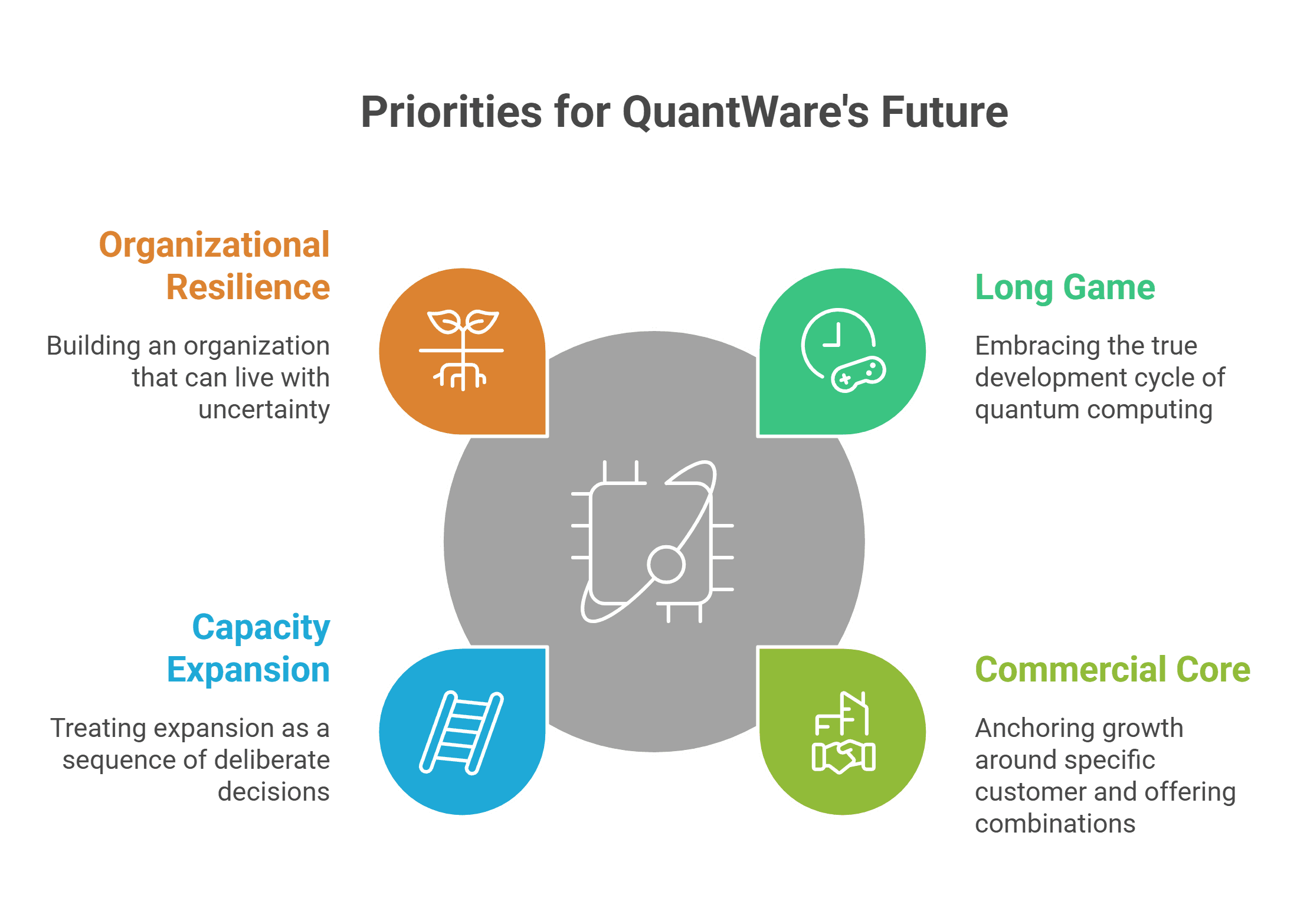
First, they will need to explicitly embrace the long game. That means setting internal and external expectations that reflect the true development cycle of quantum computing, rather than borrowing templates from faster‑moving software markets.
Second, they will need to anchor growth around a clearer commercial core. The company has many promising directions – products, services, partnerships – but not all of them will matter equally. Identifying and strengthening the specific combinations of customers, offerings and routes to market that can sustain the business through the next decade is essential.
Third, they will need to treat capacity expansion as a sequence of decisions rather than a one‑time leap. Each step up in production, hiring or geographic footprint should follow from a deliberate view of where the strongest, most durable demand is emerging.
Finally, they will need to build an organisation that can live with uncertainty without becoming paralysed by it. That includes how leadership is composed, how decisions are made, and how the company balances short‑term pressures with long‑term positioning.
These are not questions any deep‑tech company can answer once and then file away. They require ongoing, structured conversations among founders, executives, investors, and ecosystem partners.
At Growth Lantern, we work precisely at this intersection: helping technology‑driven ventures turn promising inflexion points into sustainable progress by aligning strategy, organisation and capital with the actual shape of their markets. QuantWare has already completed a remarkable first chapter; the next one will depend less on individual product announcements and more on how it navigates these slower, less visible decisions over time.
7. Implications for Dutch and European deep‑tech
QuantWare’s story is a rare and valuable example of a European deep‑tech hardware company that:
Is rooted in public research and regional ecosystems.
Has chosen an enabling, platform role in a global emerging industry.
Has attracted substantial long‑term capital to execute an ambitious plan.
For organisations like TNO, InnovationQuarter, Invest‑NL, Quantum Delta NL and their counterparts across Europe, the case highlights several priorities:
Support beyond research funding. Help ventures move through the messy middle: industrialisation, customer building, organisational growth.
Design capital stacks for long‑cycle markets. Blend public funds, strategic investors and specialist VCs to provide a runway that matches the market’s pace.
Encourage open, modular architectures. When core hardware and tools are made available to many players, the entire ecosystem can move faster.
QuantWare has already achieved more in a few years than many deep‑tech ventures manage in a decade. The next phase will be harder: living in the space between what is technically possible and what the market is ready to absorb.
If the company, investors and ecosystem can navigate that space with patience and discipline, QuantWare can do more than ship impressive chips. It can help anchor a European quantum hardware industry with global influence.